

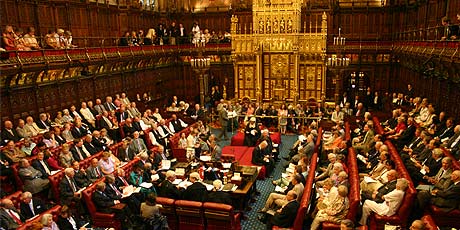
 The House of Lords has introduced an electronic newsletter for those who would like to be kept informed of forthcoming business. It is organised not so much on an institutional basis as on subject areas, so you can follow what is happening in, say, environment or education. You can find more details here.
Perhaps we could have blog posts on items in the newsletter, so you could all get easy feedback? Or is there going to be an approved response channel (I haven’t received anything yet having just signed up, so I don’t know).
Are any of the bloggers following the Local Government Finance Bill? I’d like to make some rude remarks about how poorly-written parts of it are, further eroding privacy with vague language. Ministers will probably respond by saying “Oh, we wouldn’t use it like that”, to which I’d like to tell them that in that case they ought to write down exactly how they intend it to be used and not leave it open to later abuse by local government officials.
I would also note that this isn’t the first Bill I’ve seen where sloppy wording gives much greater powers with minimal oversight than was possibly intended. I still remember anti-terrorism laws being used against Iceland for financial reasons.
Dave H: Always keen to hear of poorly drafted Bills. If there are particular sections you wish to draw to our attention, please do so.
I could start with the short summary and say “Section 15”.
The repeated use of the phrase “to a qualifying person for prescribed purposes relating to council tax” is bad. A council could argue that pretty much anything they do is related to council tax because ‘related’ is not particularly specific. If HMRC are sharing my tax information without my prior consent then I’d like the circumstances under which it can be shared to be fairly tightly defined, as well as with whom they can share it (“a person providing services” could be pretty much anyone in the world).
Legislation often assumes that all care is taken with the data, and there are penalties for misuse in the Bill, but in the real world mistakes do happen, and if the data has been sent overseas, it’s hard to prosecute for malicious disclosure, and the more people who can access information, the more chance of a mistake or legal-but-wrong usage.
I take the view that the state should not be able to help itself to my personal information without asking me first. If I’m after a rebate then I’m capable of giving consent to the council to talk to HMRC to check, but they should only be able to use that data for the specific purpose for which I’ve given permission. If the council is investigating fraud then I believe that the existing legislation already allows for HMRC to share data.
Seems helpful;
but will it be enough, and clear enough, to ‘de-obstacle-course’ British ‘sticking-in-the-mud’ defacto-oligarchy,
and effectively help every level of The People to begin becoming both participative and constructive,
as a ‘multi-way discussion’ and ‘people-upwards’, truly “all in this together”, operational Democracy’ –
maintaining ourselves ‘Co-Fit-for-Longest-Term-Purpose’ withal ?
This sounds a very good idea, however, what is this registration and why?
maude elwes: It is simply a case of signing up to receive copies electronically.
Will it be called the ‘Peer Review’?
A good idea and I’m looking forward to getting my first newsletter.
How much* do We**
need
a People-Upwards individual-citizen’s
seriously-submitted
issue, topic, and factors
Display E-Site;
complete with ‘evaluation-comments’ pages,
and ‘shortlisting-voting’, pages;
for the verbatim – and for any amended – issue, topic or factor thereto submitted ?
Interimly, could the LotB Peers & Hansard reasonably celeriously add to the Blogs in LotB
one blog (per-week) edited by a small team of impartial Hansard moderators
devoted solely,
and as far as possible verbatimly,
to publication of such individual citizen’s
issue,
topic,
and/or factor(s) ?
———
Such a peacefully-progressive ‘reform’ addition would surely help both Legislators and Electors to maintain some up-front Clarity
and thereupon-consequent hugely more effective (than hithert6o and at-present)
‘concentration & economy of energies, efforts, and timeframes’
shouldn’t it ?
among other advcantages ?
======
Lord Norton, oft-seen-as champion-topic-adherent and off-topic-censor;
I humbly wait with bated breath
lest such a ‘Public pong-pong’
[not simply between
members of the (legitimately-resident) British Isles population
and Peers-of-the-Blog;
but possibly unavoidably including Lobbyists, Commons-Members, Veiled-Interests-Saboteurs, Spin-Doctors, ‘Arthur vel Martha’ and ultimately ‘every Tom, Dick, Harry, Moll, Jill and Annie’
and even any opportunistic but alien or foreign cloaked-dagger-hostiles
‘sadduns-&-soddums-who-sign’ ]
be summarily judged ‘out of order’.
—————-
* how much = how importantly and urgently
** We =
(Top-Rulers) vel-but-preferably-ampersand (Lowermost-Peoples)
=======================
(JSDM 1057AMSun030612).
Dear Lord
I pay tribute to this excellent idea of reducing costly printing expenses and reaching a higher number of people with the advent of the growing fast technologies through this measure which I hope will also be extended to reports regarding Prime Minister’s questions in Parliament.
God save the Queen. God bless the United Kingdom.
Nazma FOURRE
Lord Norton,
I look forward to this as does another commenter. I have long received and enjoyed the one from Clarence House. The political and civic newslaetters I get here in America I sometimes enjoy but perhaps being a foreigner makes it easier to to read with the detachment the most pleasurable reading requires. Even if a discussion is about a house burning doen one can find pleasure it it is well written and intelligent. However, if the writer is describing one’s own house it is easy to be distracted from the keen argument by the prospect of sleeping in the rain or a cheap hotel…
FWSIII’s ‘innocent’ reference to “if it is well written” then even urgently vital but bad news can be a pleasure to read, goes to the very hearty, mind and spirit of currently-publishing research into human behaviour, development, psychology and sociology
which is showing increasing human-mind anomalies and ‘weak’ parts of the homo-sapiens-sapiens species that amount to ‘the natural-&-civilised human white-underbelly’,
and this little focus upon the Peers ‘keeping up to date, and up to informing The Public’
via new electronic communicational technology’
would benefit from helping every-body to see even bigger pictures influencing both our existing stumbling democratic-communication and our lack of anything better.
A few ‘snapshots’ might be:
(a) our emotional-brain always ‘kicks in’ first, before our successive intelligent-lymbic and intellectual super-lymbic brains do so;
(b) the human animal is the only animal on Planet Earth that has to learn and to be taught how to move him-her-self;
(c) (Human) System 1 thinking makes ‘intuitively’ instant responses; whereas System 2 Thinking deliberates at length before responding [a main theme in “Thinking, Fast and Slow” by Kahneman, Nobel prizewinner]
yet this ‘Systems 1 & 2 Thinking’ hypothesis jars and grates against long-previously-established (but not yet assimilated) more solid findings about Mind-Functions, Human-Movement, Self-and-Others-‘Theorisation’ Theory, and Perceptual Self-Control Theory (this latter to better-educatively, ‘live-ably’, and ‘lifespan waste-not-want-not budget-ably’,
replace Reinforcement-Theories):
published respectively by
Carl Jung
Rudolf Laban
Caroline Dweck
William Powers.
———
Relevance here ?
Two extremes prevent humans from providing urgent ‘snapshot’ action and from planning ‘deliberatively’ a longer-term solution:
(1) Being physically engulfed by a ‘disaster’ (as in being trapped on Floor 30 of a skyscraper when a bomb blasts away the foundations and the whole edifice starts toppling and crashing;
(2) Being far-remote from a ‘disaster’ (as in watching a World-At-War documentary, or sitting in a Classroom or Parliament, hearing (and perhaps even sometikmes liostening to) second and third hand stories of ‘what real life is like on-the-ground, at the battlefront, and down among the grass-roots and the underclasses themselves’.
We can see here that Parliamentarians are among the Ruling-Classes who are safe and far-removed, and are in both extremes;
they are neither in amongst the real disasters-on-the-ground,
nor of sufficient difficult-life-threatening-real-survival experience,
to be able to make either correct urgent decisions or lengthily-deliberated strategicly-sustainworthy ones.
————-
So yes, we welcome the e-communications expected-progress;
Yet still we need to be learning how to work honestly and ’governancially’ together
[and for the first time, remember]
how to be, as every political party and government has at some time “rally-cried” for us to be
“all in this together – “
but this time we need to advance in better-democratic-communication, cooperativity, & participativity.
Dear Lord
One proud man hidding under a pseudo in this blog has again been not only irrelevant but do seem to critize bloggers , instead of being subject relevant. I am deemed to ask you my Lord, with all the respect and tribute I pay to your honourable profession, to make such frustrated blogger realise the importance of relevant discussion to keep the level standard of this blog high.
With all my respect, dear Lord
Yours faithfully
Nazma FOURRE
(God save the Queen, God bless the United Kingdom)